Showing posts with label abstract art. Show all posts

Monday, October 10, 2016

FEMINIST ART

Untitled (I shop therefore I am) (1987)  Artist: Barbara Kruger  Artwork description & Analysis: This piece is characteristic of Kruger's early work, depicting a phrase placed over a photographic image from a newspaper or magazine. Kruger first worked in magazine advertising, and used her graphic design expertise in her art. The slogan in this work refers to images of women in the media, specifically product advertisements designed for women, which are usually created by men. It is a reminder that most of the media that is geared toward women is based on men's assumptions about women's desires, lives, and ideals, interrogating the belief that women only need material objects to feel happy and that men can keep them under their control by those means. Kruger's work is accessible and direct, and was incredibly influential among the artists of the 1980s.  Photographic Silkscreen/Vinyl ile ilgili görsel sonucu
"...women's experiences are very different from men's. As we grow up socially, psychologically and every other way, our experiences are just different. Therefore, our art is going to be different."        Joan Snyde

 The Feminist art movement emerged in the late 1960s amidst the fervor of anti-war demonstrations as well as civil and queer rights movements. Hearkening back to the utopian ideals of early twentieth-century modernist movements, Feminist artists sought to change the world around them through their art, focusing on intervening in the established art world, the art historical canon, as well as everyday social interactions. As artist Suzanne Lacy declared, the goal of Feminist art was to "influence cultural attitudes and transform stereotypes." There is no singular medium or style that unites Feminist artists, as they often combined aspects from various movements and media, including Conceptual art, Body art, and Video art into works that presented a message about women's experience and the need for gender equality. Feminist art created opportunities and spaces that previously did not exist for women and minority artists, as well as paved the path for the identity art and activist art of the 1980s.


  • Feminist artists sought to create a dialogue between the viewer and the artwork through the inclusion of women's perspective. Art was not merely an object for aesthetic admiration, but could also incite the viewer to question the social and political landscape, and through this questioning, possibly affect the world and incite change toward equality.
  • Before feminism, the majority of women artists were denied exhibitions and gallery representation based on the sole fact of their gender. Feminist artists created alternative venues as well as worked to change established institutions' policies to promote women artists' visibility within the art world.
  • Feminist artists often embraced alternative media, incorporating fabric, fiber, performance, and video as these materials did not have the same historically male-dominated precedent that painting and sculpture carried. By using these non-traditional media, they sought to expand the definition of fine arts to include a wider variety of media and artistic perspectives.


Important Art and Artists of Feminist Art


womanhouse judy chicago ile ilgili görsel sonucuWomanhouse (1972)

Artist: Judy Chicago and Miriam Schapiro
Artwork description & Analysis: Womanhouse was an installation that encompassed an entire house in residential Hollywood organized by Judy Chicago and Miriam Schapiro as the culmination of the Feminist Art Program (FAP) at California Institute for the Arts in 1972. The twenty-one all-female students first renovated the house, which had been previously marked for demolition, then installed site-specific art environments within the interior spaces that ranged from the sculptural figure of a woman trapped within a linen closet to a kitchen where the walls and ceiling were covered with fried eggs that morphed into breasts. Many of the artists also created performances that took place within Womanhouse to further address the relationship between women and the home. The entire collaborative piece was about reclaiming domestic space and challenging traditional female roles. It gave women a new realm to express their views within a thoroughly integrated context of art and life.
Mixed media site installation


Anatomy of a Kimono (1974)

Artist: Miriam Schapiro
Artwork description & Analysis: Anatomy of a Kimono is one of many "femmages" Schapiro created, starting in the mid-1970s, and is based on the patterns of Japanese kimonos, fans, and robes. Schapiro used the term femmage to describe works that combined collage, painting, fabric, embroidery and other "high art" and "decorative art" techniques, simultaneously highlighting women's relation to those materials and processes. The artist collected donated handkerchiefs while touring the country and cobbled them together with other fabrics to form ten large panels filled with Japanese-inspired shapes. The work adopts the monumental scale of Abstract Expressionist canvases, but by using fabric instead of paint, Schapiro elevates a utilitarian and feminine material to the realm of "high art."
Fabric and acrylic on canvasanatomy of a kimono ile ilgili görsel sonucu


Semiotics of the Kitchen (1975)

Artist: Martha Rosler
Artwork description & Analysis: Now one of the canonical works of feminist video art, Semiotics of the Kitchen examines women's relationship to the home through the trope of the televised cooking show. Rosler describes the video stating, "an anti-Julia Child replaces the domesticated 'meaning' of tools with a lexicon of rage and frustration." Rosler parodically adopted the role of the "host," and runs through an alphabetical index of kitchen utensils, illustrating their use and action with pantomime. The woman and her implements disrupt the familiar system of everyday meanings - the safely understood signs of food production erupt into anger and violence. In list of kitchen implements, states Rosler, "when the woman speaks, she names her own oppression." She, like many feminist artists of the 1970s, wished to interrupt and change the preconceived notions about women's roles within the home, and how these were represented in the mass media.
Black and white video with sound - Electronic Arts Intermix


The Dinner Party (1974-1979)

Artist: Judy Chicago
Artwork description & Analysis: The Dinner Party is one of the most well-known pieces of Feminist art in existence and is permanently housed at the Center for Feminist Art at the Brooklyn Museum. The installation consists of a large banquet table with place settings for thirty-nine notable women from history and mythology. The settings have gold ceramic chalices and porcelain plates painted with butterfly- and vulva-inspired designs. In addition to the thirty-nine settings, there are the names of 999 other women painted on the tiles below the triangular table. The Dinner Party participates in the feminist revision of history, initiated during the 1970s, in which feminists worked to re-discover lost role models for women, re-writing the past that had previously only included male voices. In the combination of intricately wrought textiles, tile, and porcelain, Chicago reclaimed the realm of "high art" to include what had traditionally been relegated to the lower status of "women's work."
Painted porcelain plates, silverware, chalices, fabric, tiles - Brooklyn Museum

Untitled (I shop therefore I am) (1987)

Artist: Barbara Kruger
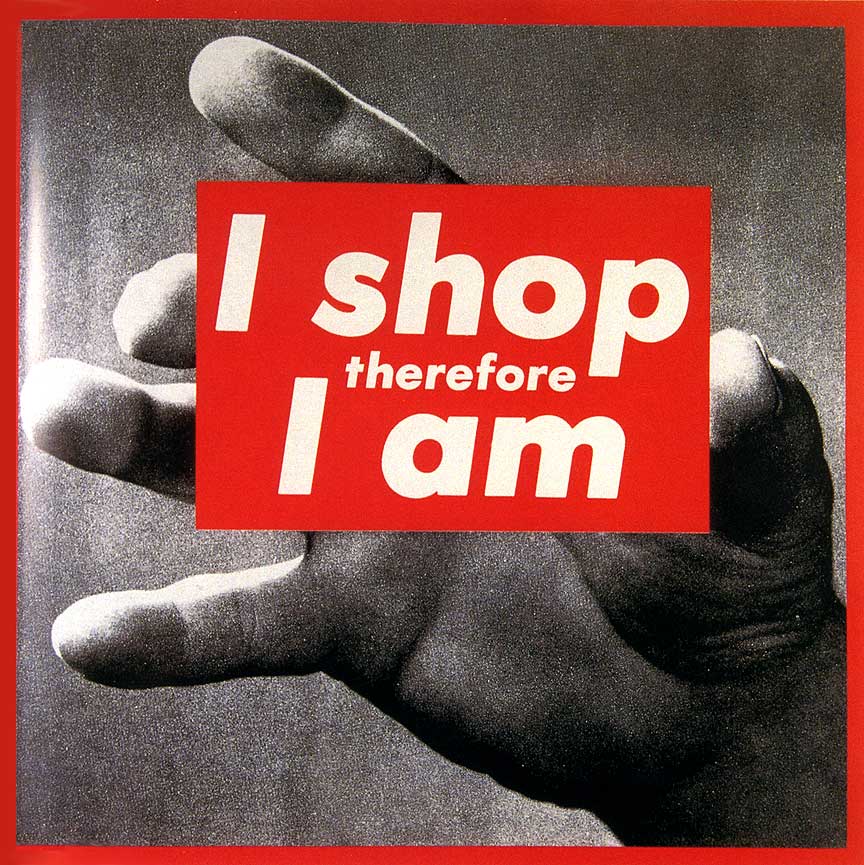
Untitled (I shop therefore I am) (1987)  Artist: Barbara Kruger  Artwork description & Analysis: This piece is characteristic of Kruger's early work, depicting a phrase placed over a photographic image from a newspaper or magazine. Kruger first worked in magazine advertising, and used her graphic design expertise in her art. The slogan in this work refers to images of women in the media, specifically product advertisements designed for women, which are usually created by men. It is a reminder that most of the media that is geared toward women is based on men's assumptions about women's desires, lives, and ideals, interrogating the belief that women only need material objects to feel happy and that men can keep them under their control by those means. Kruger's work is accessible and direct, and was incredibly influential among the artists of the 1980s.  Photographic Silkscreen/Vinyl ile ilgili görsel sonucuArtwork description & Analysis: This piece is characteristic of Kruger's early work, depicting a phrase placed over a photographic image from a newspaper or magazine. Kruger first worked in magazine advertising, and used her graphic design expertise in her art. The slogan in this work refers to images of women in the media, specifically product advertisements designed for women, which are usually created by men. It is a reminder that most of the media that is geared toward women is based on men's assumptions about women's desires, lives, and ideals, interrogating the belief that women only need material objects to feel happy and that men can keep them under their control by those means. Kruger's work is accessible and direct, and was incredibly influential among the artists of the 1980s.
Photographic Silkscreen/Vinyl


Sunday, October 12, 2014

MOST POPULAR ART BIENNALES

Art Biennales

Whether you spell it the European way 'biennale' or the American way 'biennial', the meaning is the same: a mega art exhibition which takes place every two years.

The Biennial became an increasingly important international art exhibition, especially during the 1990s and sprouted in numerous cities. The Biennial also helped shift the focus of art from the major art centers to other locations, while aiding the local tourism industry.

The Venice Biennale


The Venice Biennale is the granddaddy of them all. Established in 1895, when world's fairs were the trend, the art from various nations were showcased in the Giardini (the Garden), which is host to several national pavilions, each with its own unique history of architectural development.
The huge exhibition has expanded in size throughout the city of Venice, with new pavilions and exhibition sites being added each time. The Venice Biennale takes place from June to November during odd-numbered calendar years.

 The São Paulo Biennial
 The São Paulo Biennial in Brazil began in 1951 and takes place during even-numbered years. It is the biggest and oldest biennial in the Americas and it features Brazilian, Latin American and international contemporary art in its curated thematic exhibitions.


 Documenta

 Documenta in Kassel, Germany is not a biennial, since it is held every 5 years. However, it ranks in prestige and importance with the world's top biennials and triennials.

During its opening preview, arts professionals including artists, curators, museum directors, critics, art dealers, etc. from around the world attend. Established in 1955, documenta is one of the major must-see art exhibitions.

 The Istanbul Biennial

The Istanbul Biennial in Turkey began in 1987 and takes place in the fall of odd-numbered years. It is one of the most prestigious art exhibitions for international contemporary art.
Like many of the other biennials, the art curator is chosen by committee. The curator then develops the concept, theme and list of artists for the exhibition.
Another main feature of biennials is that they are not isolated museum exhibitions, but rather involve the entire city in its make-up, so parts of the biennial exhibition take place in galleries, abandoned factories, public parks, waterfronts, etc. There will also be seminars, workshops, tours, film screenings, etc.

 The Lyon Biennial

 The Lyon Biennial in Lyon, France was founded in 1984 and is held from September to December in odd-numbered years. It is highly regarded for its carefully crafted thematic exhibitions.


 The Berlin Biennial

 The Berlin Biennial is located in Berlin, Germany which is one of the biggest and most popular international artist communities in the world. Modeled after the Aperto exhibition in the Venice Biennale, the Berlin Biennial was established in 1998 to promote cutting-edge contemporary art and to reflect the city's importance as a vital art center. 


 The Shanghai Biennale

 The Shanghai Biennale in China started in 1996 as an exhibition of local artists using traditional Chinese ink-painting techniques. In the year 2000, the seminal exhibition curated by Hou Hanru featured conceptual art, installation art, new media, video and digital art to create an international biennial


 SOURCE:http://fineart.about.com/od/International-Art-Exhibitions/tp/top-15-international-art-biennial-exhibitions.01.htm

Monday, August 12, 2013

SOYUT SANAT

File:Robert Delaunay, 1913, Premier Disque, 134 cm, 52.7 inches, Private collection.jpg

 Robert Delaunay, 1912-1913, Le Premier Disque


Soyut sanat, genel anlamıyla doğada varolan gerçek nesneleri betimlemek yerine, biçimler ve renklerin, temsili olmayan veya öznel kullanımı ile yapılan sanata denir. Nonfigüratif sanat terimi ile değişmeli olarak kullanılır. 20. yüzyıl başında bu terim, gerçek biçimleri sadeleştirilmiş veya değiştirilmiş halleriyle imgelere indirgeyen Kübist ve Fütürist sanatı tanımlamak için de kullanılmıştır.
 emsili olmayan sanat aslında bir 20. yüzyıl icadı değildir. İslam ve Musevi geleneklerinde insanların resmedilmesinin yasak olması nedeniyle bu kültürlerde süsleme sanatları önemli derecede gelişmiştir. Bunlara örnek olarak gösterilebilecek kaligrafi ve hat sanatı da nonfigüratif sanatlardır. Batı kültüründe de soyut tasarımların kökü eskilere dayanır. Bunlara rağmen, soyut sanat süsleme sanatlarından farklı olarak, dekoratif değil güzel sanatlar adı altında incelenir. Bunun nedeni soyut sanat eserinin kendi başına, sanatçının sadece eserin kendisine yoğunlaşmasıyla ortaya çıkmasıdır.

 Wassily Kandinsky, doğadaki dinamik kuvvetlerle uğraşarak madde hakkında bilgimizi artıran bilimin yanında, sanatın görsel dünyanın ardındaki ruhsal güçleri göstermesi gerektiğine inanıyordu. Kandinsky ile Kazimir Malevich ilk defa tamamen soyut olarak nitelendirilebilecek resimler yapmışlardır.


 Abstract art uses a visual language of form, color and line to create a composition which may exist with a degree of independence from visual references in the world.

 Western art had been, from the Renaissance up to the middle of the 19th century, underpinned by the logic of perspective and an attempt to reproduce an illusion of visible reality. The arts of cultures other than the European had become accessible and showed alternative ways of describing visual experience to the artist. By the end of the 19th century many artists felt a need to create a new kind of art which would encompass the fundamental changes taking place in technology, science and philosophy. The sources from which individual artists drew their theoretical arguments were diverse, and reflected the social and intellectual preoccupations in all areas of Western culture at that time.

 Abstract art, nonfigurative art, nonobjective art, and nonrepresentational art are loosely related terms. They are similar, but perhaps not of identical meaning.

 Much of the art of earlier cultures – signs and marks on pottery, textiles, and inscriptions and paintings on rock – were simple, geometric and linear forms which might have had a symbolic or decorative purpose. It is at this level of visual meaning that abstract art communicates. One can enjoy the beauty of Chinese calligraphy or Islamic calligraphy without being able to read it.

  Kazimir Malevich-Black Square


File:Black Square.jpg
 Wassily Kandinsky, On White 2, 1923

 File:Kandinsky white.jpg


 "There is no abstract art. you must always start with something. afterward you can remove all traces of reality."             
                                                                                                               PICASSO